
Beginner Gold Trading, XAUUSD & Swing Trading Education
Beginner Gold Trading, XAUUSD & Swing Trading Education
Gold trading styles can vary significantly, especially when comparing scalping, intraday trading and swing trading. Each approach uses different holding times, levels of screen time and decision-making speeds. Therefore, beginners should understand how these methods differ before deciding which style may fit their schedule, personality and trading plan.
First, scalping is a short-term trading style that aims to capture relatively small price movements. A scalper may enter and exit several trades during one session and often watches the chart closely while a position is open.
Scalpers often use lower timeframes to look for short-term entries and quick price reactions.
Several setups may appear during one session, which can mean more entries, exits and opportunities to make mistakes.
Because positions can develop quickly, scalping often requires close attention while the trade is active.
Intraday trading, also called day trading, generally means opening and closing an XAUUSD position within the same trading day. Therefore, the trader may hold a position longer than a scalper but usually does not intend to carry the trade overnight.
An intraday position may stay open through part of the London or New York session rather than being closed after only a small move.
Intraday traders often focus on movement that develops during one trading session or during the London–New York overlap.
Closing before the trading day ends can reduce overnight exposure, although normal trading risk still remains.
Swing trading, on the other hand, usually focuses on larger market moves that may develop over several hours or multiple days. As a result, swing traders often spend less time reacting to every small price movement.
Swing traders may rely more heavily on broader market structure, trend direction and larger support and resistance zones.
Because the goal is to capture a larger move, there may be fewer trades during the week.
A planned stop loss and take profit can allow a position to develop without watching every candle.
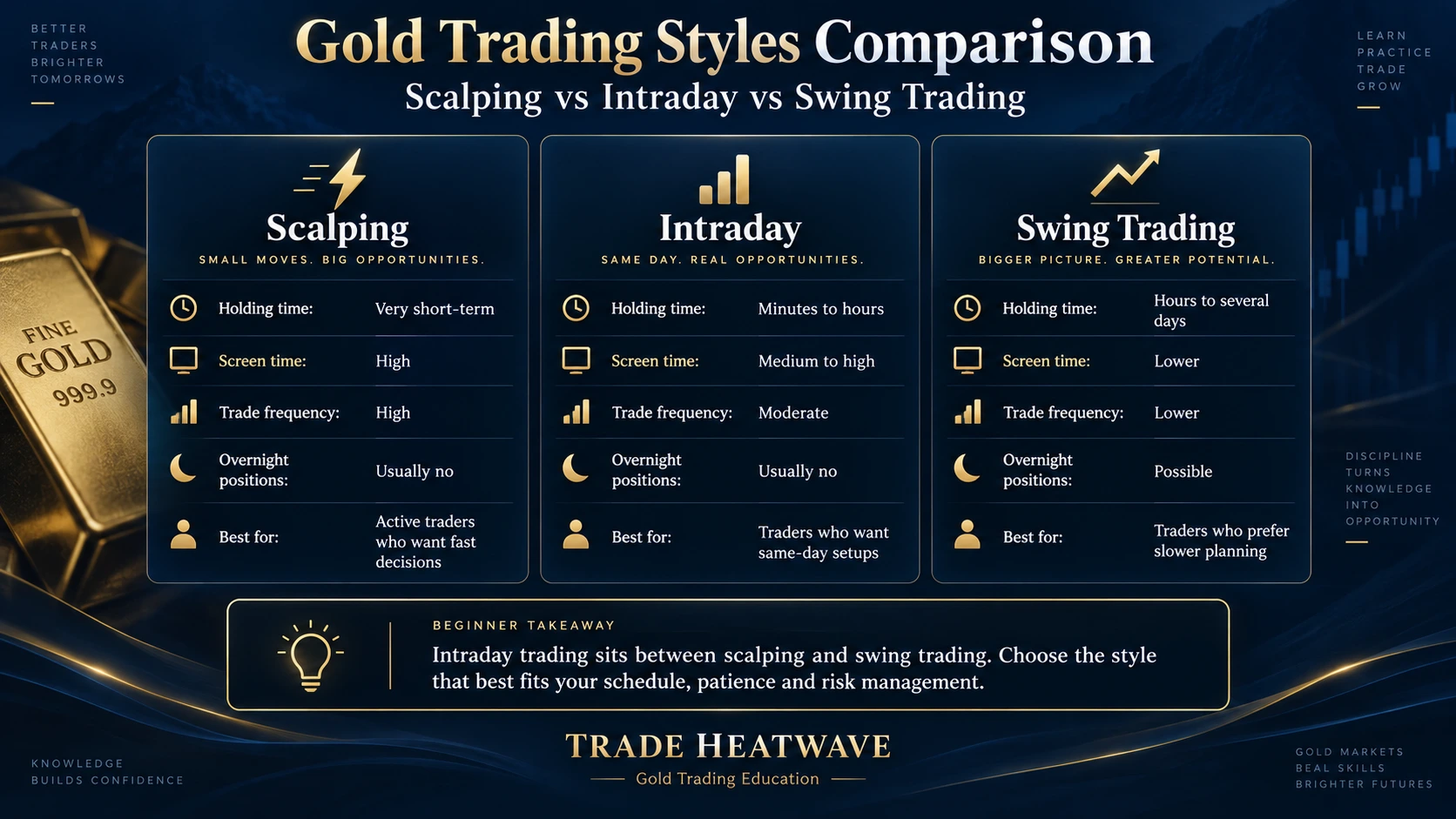
Although these gold trading styles can overlap, the main differences are usually how long a trade remains open, how frequently decisions are made and how closely the market needs to be monitored.
| Factor | Scalping | Intraday / Day Trading | Swing Trading |
|---|---|---|---|
| Holding Time | Very short-term | Minutes to hours | Hours to several days |
| Overnight Positions? | Normally no | Normally no | Possibly yes |
| Trade Frequency | Higher | Moderate | Usually lower |
| Screen Time | High | Medium to high | Generally lower |
| Decision Speed | Fast | Moderate to fast | Usually slower |
| Main Focus | Small short-term moves | Movement during one trading day | Larger market structure |
| Common Challenge | FOMO and overtrading | Forcing trades during the session | Patience and overnight risk |
Scalpers generally avoid holding trades for long periods because the goal is to capture shorter moves.
Active sessions can create several opportunities to practice short-term price reading.
Because trades are shorter, a trader may learn relatively quickly whether the setup worked.
However, faster trading can create more emotional pressure. A beginner may feel the need to chase moves, enter late or immediately recover a loss. Consequently, scalping can encourage overtrading when discipline is weak.
Fast price movement can make traders feel they must enter before the opportunity disappears.
More available setups can lead to unnecessary trades when someone feels pressure to stay active.
A quick loss can tempt a trader to enter another position immediately in an attempt to recover money.
Intraday trading can provide more time than scalping while still allowing the position to be closed before the day ends. As a result, it may appeal to traders who want active market participation without constantly entering and exiting very short trades.
Traders may have more time to evaluate the setup before making a decision.
Intraday traders generally aim to close positions before carrying them into the next trading day.
Some traders concentrate on London, New York or the overlap instead of watching the market all day.
Nevertheless, day trading can create pressure to find a trade simply because the session is open. Therefore, beginners should avoid assuming they need to trade every day.
Swing trading can provide more time to analyse the chart before entering. In addition, it may fit more easily around work, family or other responsibilities because the trader is not trying to react to every short-term price movement.
Higher-timeframe setups can give traders more time to identify levels, calculate risk and decide whether the trade makes sense.
Because there may be fewer setups, the trader can focus on waiting rather than constantly looking for action.
Swing trading may be easier for people who cannot watch XAUUSD continuously throughout the day.
Nevertheless, swing trading is not easy simply because trades last longer. Holding positions for extended periods can expose an account to overnight movement, economic news and changing market conditions.
Price can move while you are sleeping or away from the chart.
Waiting hours or days for a trade to develop can be difficult for someone who wants constant action.
A swing position may remain open through important economic announcements unless the trader plans around them.
There is no universal answer. However, beginners who are still learning chart structure, position sizing and emotional control may benefit from choosing a pace that gives them enough time to think before acting.
First, decide whether you can realistically monitor fast-moving positions during active trading sessions.
Next, consider whether quick price movement causes you to become impulsive or chase entries.
Then, decide whether you are comfortable holding a position while away from the market or overnight.
Finally, choose the style that makes it easier to follow risk management rather than the one that looks most exciting.
For scalpers and intraday traders, active periods such as the London–New York overlap may be especially important because short-term volatility creates movement. Swing traders, by comparison, may focus more on the broader setup while still remaining aware of major news events.
Regardless of trading style, traders still need to understand where price is relative to important market structure. Therefore, support and resistance remain useful whether a trade lasts several minutes, several hours or several days.
Most importantly, scalping, intraday trading and swing trading can all lose money when position sizing is poor. Therefore, lot size, stop loss and total account risk should be planned before every trade.
Learn how lot size changes the amount of money exposed to a move.
Plan the exit and risk before entering the market.
If you are new to gold, start with the basic market terminology.
Instead of choosing a trading style simply because someone else recommends it, beginners can test different approaches on demo. For example, compare fast scalping, same-day intraday setups and slower swing-style planning.
Ultimately, the better trading style is the one that allows you to follow a repeatable process. Scalping is not automatically more profitable, intraday trading is not automatically safer and swing trading is not automatically easier. Consistency and risk control matter more than the label.
Build your XAUUSD skills one topic at a time before increasing risk.