
TRADE HEATWAVE WEEKLY GOLD RECAP
Gold Weekly Recap: Why U.S. Debt May Matter More Than the Next Fed Rate Move
Gold traders spent much of the week watching inflation, Federal Reserve expectations and rising Treasury yields. However, another major issue was developing in the background: U.S. federal debt moved above $40 trillion.
As a result, XAUUSD traders were faced with two very different forces. In the short term, higher interest-rate expectations created pressure on gold. At the same time, growing government debt and higher borrowing costs continued to strengthen the longer-term debate about gold as a diversification asset.

Week covered: September 7–11, 2026
Friday spot gold: approximately $4,350–$4,360 per ounce during trading
Weekly move: approximately 1.5% lower
Main themes: inflation, Federal Reserve expectations, Treasury yields, U.S. debt and geopolitical uncertainty
What Happened to Gold This Week?
Gold recovered strongly on Friday after facing pressure earlier in the week. According to Reuters, spot gold climbed more than 1% during Friday's session and traded around $4,363 per ounce. Nevertheless, gold remained roughly 1.5% lower for the week.
The main reason was a change in interest-rate expectations. U.S. inflation data strengthened the market's belief that the Federal Reserve could raise rates again at its September meeting.
Therefore, even though investors continued to view gold as a potential hedge against economic and geopolitical uncertainty, higher interest-rate expectations created an immediate headwind.
This is an important lesson for beginners. Gold does not move because of one headline alone. Instead, XAUUSD can react simultaneously to inflation, interest rates, Treasury yields, the U.S. dollar, government borrowing and investor risk sentiment.
Why the Next Federal Reserve Decision Matters
The Federal Reserve is scheduled to hold its next policy meeting on September 15–16, 2026. Consequently, traders are watching closely for signs that policymakers may raise interest rates again.
Reuters reported that market expectations for a quarter-point rate increase rose sharply after the latest inflation data. In addition, investors have been watching oil prices because higher energy costs can add further inflation pressure.
However, traders should not focus only on whether the Fed raises rates. The accompanying statement, economic projections and press conference may be just as important because they can influence expectations for future policy.
In other words, the market may react not only to what the Fed does, but also to what it signals could happen next.
If you are still learning how major announcements influence gold, read: How Economic News Affects XAUUSD .
Why Can Higher Interest Rates Pressure Gold?
Gold does not pay interest. Therefore, when bond yields rise, investors can earn more income from assets such as U.S. Treasury securities. Consequently, the opportunity cost of holding a non-yielding asset such as gold can increase.
A Simple Beginner Example
Imagine an investor choosing between gold and a government bond. Gold may rise or fall in value, but it does not pay interest.
Meanwhile, if a Treasury security offers a relatively high yield, some investors may prefer that income. As a result, money can temporarily move away from gold.
Nevertheless, the relationship is not automatic. Higher rates do not guarantee that gold will fall because investors may still buy gold for diversification, inflation concerns, geopolitical risk or uncertainty about currencies and government finances.
U.S. Treasury Yields Moved Close to 5%
Another major development occurred in the bond market. The U.S. 10-year Treasury yield briefly approached the 5% level and reached its highest area in several years before easing.
Rising Treasury yields can matter significantly for gold. First, they can increase the attractiveness of interest-bearing assets. Second, they can raise borrowing costs throughout the economy. Finally, they can increase the government's own cost of servicing its debt.
Therefore, a rising yield can create both a short-term challenge and a longer-term question for gold traders.
In the short term, higher yields may pressure XAUUSD. However, if those yields reflect increasing concerns about inflation, government borrowing or fiscal sustainability, the longer-term interpretation can become more complicated.
Why the $40 Trillion U.S. Debt Level Matters for Gold
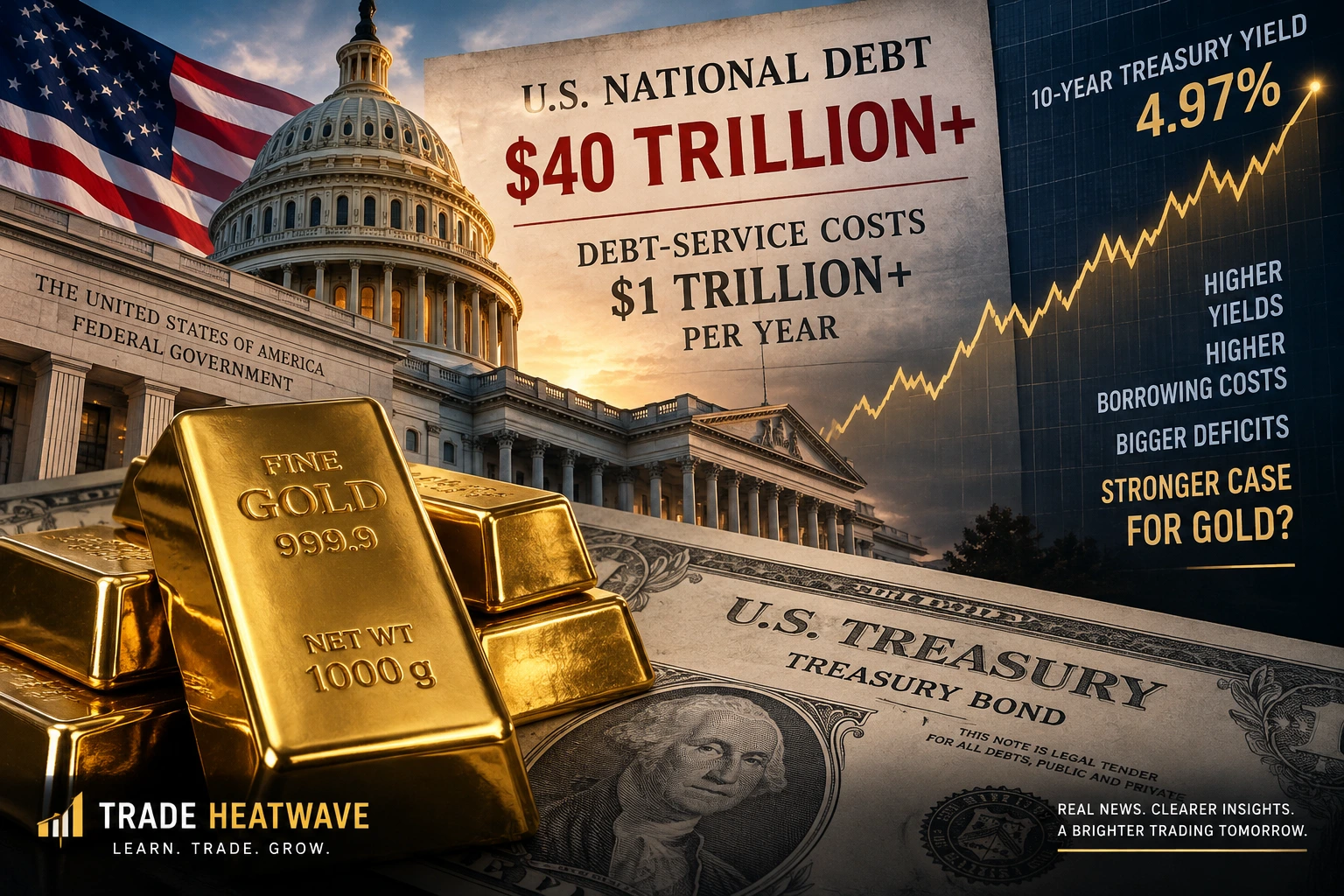
U.S. federal debt has now moved beyond $40 trillion. At the same time, higher interest rates are making that debt more expensive to finance.
This matters because interest costs eventually become part of the broader federal budget problem. As borrowing costs rise, a larger amount of government revenue may need to be used simply to service existing debt.
Furthermore, larger deficits can require additional borrowing. That can lead investors to ask whether rates can remain extremely high indefinitely without creating additional pressure elsewhere in the financial system.
The Gold Market's Dilemma
Higher interest rates: can make bonds more attractive and create short-term pressure on gold.
Higher government debt: can increase concerns about deficits, debt-service costs, inflation and the future purchasing power of currencies.
Therefore, the same high rates that can initially pressure gold can eventually contribute to broader fiscal concerns that some investors use as a reason to own gold.
Why Some Analysts Are Watching Debt More Closely Than the Next Rate Hike
Kitco News raised an important argument this week: traders may be paying too much attention to the next 25-basis-point Federal Reserve move and not enough attention to the next trillion dollars added to U.S. debt.
The argument is not that interest rates no longer matter. In fact, they matter greatly. Instead, the point is that the Federal Reserve may eventually face limits on how aggressively it can keep rates elevated when the federal government itself must finance an enormous amount of debt.
Therefore, monetary policy and fiscal policy can begin pulling in different directions.
For a beginner gold trader, this provides a much healthier way to think about the market. Rather than assuming that one rate hike automatically makes gold bearish, consider the larger economic environment in which the rate hike is taking place.
Short-Term Gold Pressure vs. the Longer-Term Gold Story
This week's market action demonstrates why traders should separate short-term catalysts from longer-term themes.
Possible Short-Term Gold Headwinds
- Higher Federal Reserve rate expectations
- Rising Treasury yields
- A stronger U.S. dollar
- Persistent inflation
- Profit-taking after previous gold gains
Possible Longer-Term Gold Support
- Growing U.S. government debt
- Large federal deficits
- Higher debt-service costs
- Persistent inflation concerns
- Geopolitical uncertainty
- Demand for portfolio diversification
Consequently, a trader can have a longer-term bullish view of gold while still expecting short-term declines, pullbacks or periods of consolidation.
What Can Beginner XAUUSD Traders Learn From This Week?
1. Do Not Trade a Headline by Itself
A headline saying inflation increased does not automatically tell you to buy or sell gold. Instead, look at how the market actually reacts.
For example, gold can initially fall after inflation data because yields rise. However, it can later recover if investors begin focusing on broader economic or geopolitical risks.
2. Watch Treasury Yields
Many beginner traders watch the U.S. dollar but ignore the bond market. However, Treasury yields can provide useful information about interest-rate expectations and investor positioning.
3. Separate News From Market Structure
Economic news can produce a large candle without necessarily changing the entire trend. Therefore, traders should first understand the broader structure and then decide whether the news reaction confirms or challenges that structure.
Learn more here: How to Identify XAUUSD Trend Direction .
4. Understand Buyers and Sellers
Markets move because buyers and sellers continuously compete for price. News events can suddenly change that balance by bringing new orders into the market.
If you want a clearer explanation, read: How Buyers and Sellers Move Gold Price .
5. Protect Your Risk Around Major News
CPI releases and Federal Reserve decisions can produce rapid price movement, sharp reversals and wider spreads. Therefore, beginners should avoid increasing position size simply because they believe they know which direction gold will move.
Instead, plan the amount you are willing to lose before entering. You can review: Risk-Reward in Gold Trading .
What Should Gold Traders Watch Next?
The next major event is the Federal Reserve's September 15–16 policy meeting. However, the rate decision itself is only one part of the picture.
Traders should also watch the Fed's projections, its explanation for the decision and comments about future inflation and interest rates.
Trade Heatwave Watchlist
- Federal Reserve interest-rate decision
- Federal Reserve economic projections
- Comments from Fed officials
- 10-year U.S. Treasury yield
- U.S. dollar direction
- Oil prices and inflation expectations
- Gold support and resistance levels
- Geopolitical developments
Most importantly, watch the market's reaction rather than assuming the headline alone tells you what gold should do.
Continue Learning About What Moves Gold
If some of the concepts in this recap are new to you, continue with these Trade Heatwave beginner guides:
Trade Heatwave Takeaway
Gold finished the week caught between two powerful forces.
On one side, higher inflation and rising interest-rate expectations pushed Treasury yields higher and created pressure on the non-yielding metal.
On the other side, U.S. debt above $40 trillion, rising borrowing costs and continuing geopolitical uncertainty reinforced the longer-term argument for holding gold as part of a diversified portfolio.
Therefore, the main lesson is not simply "rates up, gold down."
Instead, XAUUSD traders should consider several pieces together: inflation, Federal Reserve policy, Treasury yields, the U.S. dollar, government debt, geopolitical risk and market structure.
Understanding how those factors interact can help beginners become less reactive to individual headlines and more focused on the broader market environment.
Sources and Further Reading
This Trade Heatwave weekly recap provides independent educational commentary based on publicly reported market information.
Want to Learn More About Gold Trading?
Trade Heatwave was created to help beginners better understand XAUUSD, market structure, risk management and the events that can influence gold prices.
I also completed the Gold Boss Academy training program. Therefore, if you are researching structured gold-trading education, you can read about my own experience before deciding whether it is right for you.
Educational Disclaimer: Trade Heatwave provides educational information only and does not provide financial or investment advice. Gold, forex and leveraged trading involve substantial risk. Market conditions can change quickly. Always conduct your own research and use appropriate risk management.